
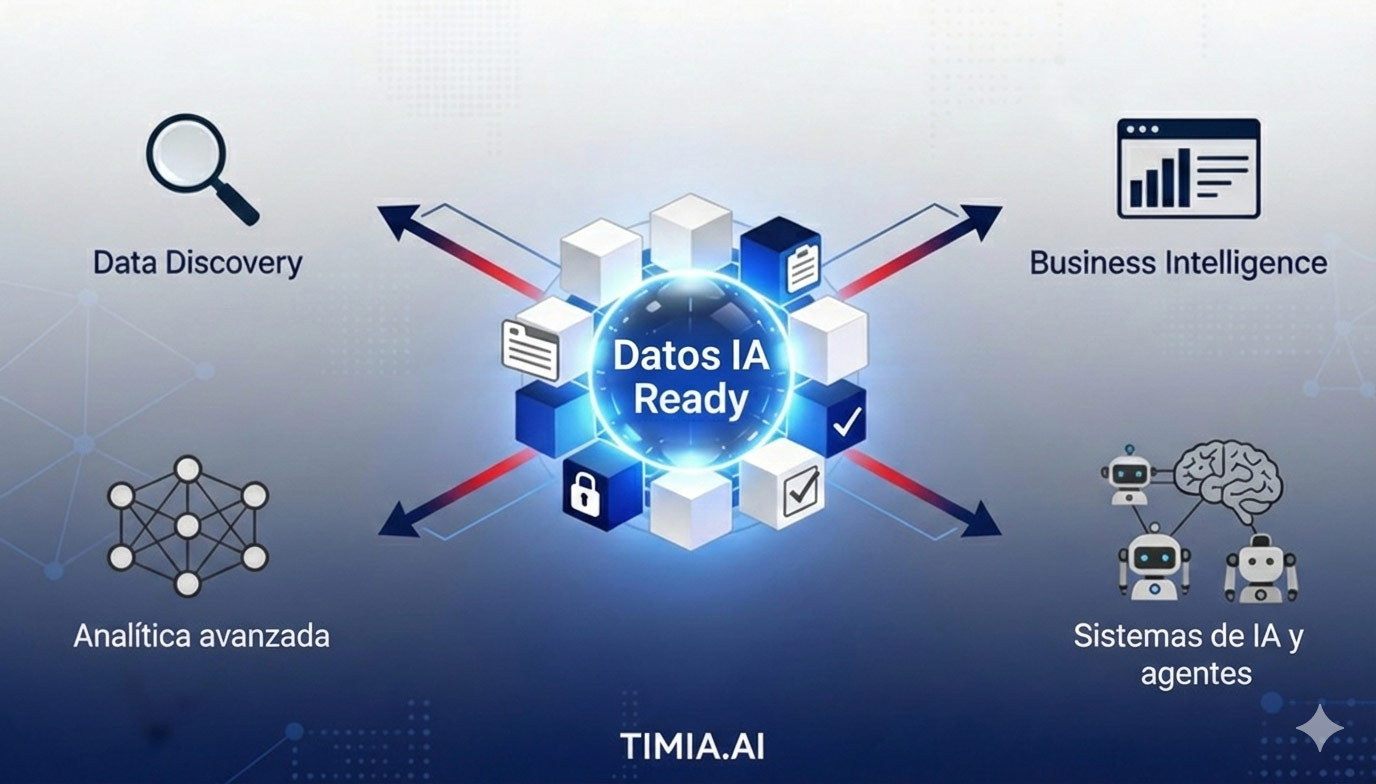

Being AI Data Ready goes beyond implementing artificial intelligence. It involves having governed, high-quality data with clear accountability, managed throughout its entire lifecycle. Only with this foundation can AI scale, generate real value, and support sustainable business decisions.
Every week, new articles appear on advances in generative AI techniques, use cases with analytical models that improve results, and endless promises associated with advanced analytics. But the reality is that all analytical systems (regardless of how advanced the technique we use may be) have a common foundation: data.
We have been talking for many years about the need to govern our information and how quality and governance are key to ensuring decision-making (data-driven organizations) and guaranteeing the outcome of our processes. The problem in many cases is the cost of governance projects, the need for cultural change, and the complexity of obtaining a direct ROI from initiatives, which makes them very complex projects, with a great need for sponsorship and a clear and stable strategy that allows us to move forward in the initial development that offers us the first valuable results.
It is true that technological advances are exponential, but they will not be useful if we cannot make data available in an accurate, complete, consistent, accessible, and secure manner. We have been trying to convey this message to company management and business units for a long time, as they are the actual owners of the data and the ones who know it best and can guarantee its quality.
The first point is to differentiate between data access systems and having a large data lake with a very flexible architecture, which does not guarantee that the data will be "ready" for AI and decision-making systems. When we talk about "data ready," we are referring to combining three dimensions associated with the data life cycle:
In today's post, we want to focus more on lifecycle management, largely because the figures and roles are well known to everyone and the challenge at this point lies in managing change and getting the organization's culture to align with the principles of governance and information quality, which is no easy task and for which there are no magic formulas. It is important to have the sponsorship of senior management and to choose projects that generate results and "ambassadors" for that culture.
When it comes to the life cycle, we need to understand the importance of all stages, from creation and capture to the phase of secure disposal and destruction of information. This last point is becoming increasingly relevant, as proper version management will be a basic element in the appropriate responses of AI systems based on LLMs.
According to Gartner analysis, 63% of organizations lack AI-ready data management practices, and 60% of AI projects without data preparation will be abandoned before 2026. This deficiency is not technical—it is strategic: companies invest in AI tools without ensuring that their data is consumable by those tools.
Reviewing the stages that data goes through within the organization is key to enabling us to evaluate and detect the phases in which value is generated and where quality or traceability is lost or there is a risk of regulatory non-compliance.
The main stages on which to focus the analysis are:
Now that we have reviewed the data lifecycle, the question is: is your organization ready to take the leap and review whether its information guarantees the success of its analytical strategy?
Answer the following questions and ask yourself: where do I start to ensure that the basis for my decisions is sound?
If most of the answers in this short test are "no," then many of the AI initiatives being carried out in the organization will likely fail or be generated as isolated use cases that are unlikely to scale.
Having an AI Data Ready strategy is not an option; it is a prerequisite for ensuring that investments in data and technology translate into better decisions, efficiency, and sustainable competitive advantage.
FAQs
Maturity should be measured by combining business, governance, and data operation indicators. Beyond checklists, it is essential to evaluate end-to-end traceability, measured and monitored quality levels, clarity of ownership, and the degree of actual reuse of data in decisions and models.
An initiative is ready when data can be consumed reliably, repeatably, and explainably by different models and teams. This involves having complete metadata, automated quality rules, information versioning, and access controls aligned with risks and regulations. If the data is understandable, reliable, and stable over time, the organization can move toward AI without compromising results or scalability.
The key is to integrate governance, quality, and traceability into the natural flows of business and analytical processes, avoiding parallel layers. Automating controls, enabling governed self-service, and aligning the data lifecycle with actual decision moments reduces friction, accelerates adoption, and ensures that data supports the business without becoming an operational burden.